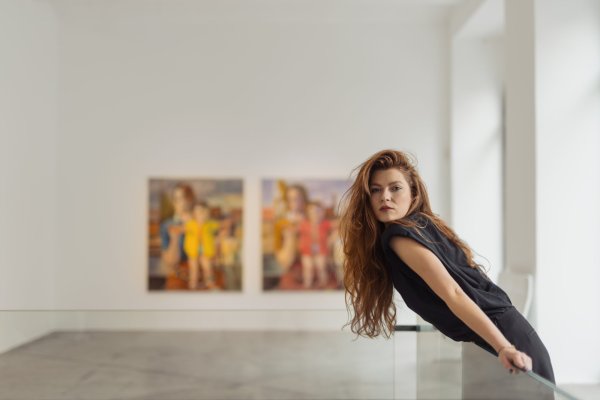
Karolína Juřicová (1992, Zlín) is an art and architecture historian, curator, gallerist and collector. She studied theory and history of art at Palacký University in Olomouc. During her studies she started to gain work experience and worked as a curator of the architecture collection at the Regional Gallery of Fine Arts in Zlín. She was involved in publishing the PZ magazine and also worked in PR. Later she moved to Prague, where she began to focus on contemporary art and representing Czech and foreign artists. As a curator, she has been exhibiting in the private sector and in institutions. For more than six years she has worked at DSC Gallery, curated with HYB4 Gallery, Platform 15 in Prague, Václav Chad Gallery in Zlín, GaP in Znojmo and other institutions. She has also curated a community of studios in Libeň (Liebeň Art Contemporary, Prague).
This interview was given on the occasion of a lecture On collecting and curating exhibitions, which Karolína Juřicová gave at the Telegraph as part of Contemporary Art Collecting Lecture Series.
You studied Theory and History of Art at Palacký University in Olomouc, specifically you studied architecture with Professor Švácha. Personally, I can say that nobody motivated me during my studies like he did. Did you ever explore the possibility of doctoral studies together? And did you have a moment similar to what happened with your originally planned application to Jiří Petrbok at the Academy of Fine Arts, when you realized that this would not be the right path for you?
I can confirm this with my experience. Professor Švácha was and is a person who inspired me and gave me access to all spheres of architecture. I think he can explain, like few others, what all the contents architecture entails, how it mirrors society and shows values. I have always been fascinated by the history of architecture and enjoyed exploring individual phenomena that were typologically different. However, by the time I finished my Master's degree, I had become deeply immersed in the private world of galleries and contemporary art. I had no more time left to continue. I regret that I did not pursue it further, even though cultural houses then became a hot topic, and a comprehensive monograph, Enlightenment, Culture, Entertainment: Cultural Houses in Czechoslovakia (2024), edited by M. Janečková and I. Lehkožívová, was published.
Is there anything you miss from the academic world?
I undoubtedly miss the lectures, the research in the archives, the focus on a specific substance that the historian examines and composes a story according to the information found, which he reconstructs with the passage of time. What I actually miss about it is the community of like-minded people who are passionate about tracing the gaps that have not been included in the canon of art history. In everyday professional life, there aren't many opportunities to relate back to that kind of environment.
Just after graduating, you started working at the Regional Gallery in Zlín. Do you remember the moment when you learned that you could fill in as a curator there? Is there something you brought back to Prague from Zlín as a skill that you probably wouldn't have acquired without Zlín?
I actually started working at the Regional Gallery of Fine Arts in Zlín while I was studying for my bachelor's degree, when I assisted the curator of the Architecture Collection, Master Ladislava Horňáková, on an internship. Thanks to her, I was able to get acquainted with the regular practice and then I also represented her in this position during her absence, and I was also put in charge of the editorial office of the magazine Prostor Zlín and the institution's PR with the public. I still draw from my cradle in Zlín, and I learned the importance of interpersonal relationships and not being afraid to connect the right people to collaborate. And also that you never know who you are accompanying, and this gives you the opportunity to meet interesting people.
If you had to have one foreign "base" besides Prague, where would it be and why?
I confess that during my time as a curator and gallery owner I have had many opportunities to travel. Berlin was the closest to my heart, and at one time it was like a second home for us. The first time I was in Berlin was in 2018 and then I went there several times a month from 2020 onwards, so I would choose Berlin as a base because of the contacts one has made there and having someone to turn to. But I probably wouldn't choose it as a place to live. After all, there are very few days when it's sunny there.
Was there ever a moment when working abroad was close - an application, an offer, a curatorial residency? What possibly stopped it/why didn't it work out?
I never applied for curatorial residencies, I made an exception only last year when I tried to apply for the Delfina Foundation curatorial residency in London, but unfortunately my project and directed research didn't match well enough with the year they were looking for suitable candidates from Eastern Europe.
You mentioned in the past that you would like to do a Jessie Makinson exhibition in Prague. Is that still on the table? And what's the biggest obstacle today?
One of my big favourites among female painters has been Jessie Makinson for a few years now. Her work has captivated me. I would definitely be interested in including her in a curatorial project themed around mysticism and witchcraft. Her paintings are populated with figures of nymphs and fauns who find themselves in ritualistic ceremonies of pagan customs and cast curses.
I am usually a hindrance to myself, often afraid to approach the artist or those I sympathize with, and miss opportunities for fear of rejection.
During your talk on Collecting in the Telegraph, you mentioned that there are new art fairs in the Middle East (Abu Dhabi, Doha, etc.). What do you think that would do to what will be considered "good" art?
Yes, as has long been announced, for the first time there will be an Art Basel Qatar fair in Doha this February. This makes it the fifth place in the world where the most important fair of our time is being held. Alongside this, Frieze Abu Dhabi will also be held for the first time in November, which will be the eighth global edition of this fair. I think these venues will become lucrative opportunities for the European art market, where the main transactions will move. Both destinations want to attract new generations of collectors from this area.
In the Face project, which you prepared with Filip Kazda and Michal Štochl for HYB4 Gallery in Prague, you agreed not to name the artists. What happened to the audience when the artists were not signed? Were they bolder in their interpretation? And did any of the artists refuse to collaborate with you due to anonymity?
This exhibition concept was done last year and I think it met our expectations. The exhibition captured very well how strong the individual artists are in their handwriting and many of them were revealed among the visitors. I think the viewer interaction deepened and it was great that it made everyone stop longer at a drawing or painting and try to decipher who they were. At the same time, it's much freer than if your eyes don't run straight to the name. No one refused to participate from the artists contacted. It was a great pleasure to realize this idea. The only author who signed the paper format was Jiří G. Dokoupil, who sent the drawing from Madrid. He included the signature in the drawing and forgot to leave it out.
In your words, you can "fold this project into plates and send it on". Have you considered where you would like to present the project?
Yes, we are still thinking about it and would like to offer it to Czech centres abroad. We have also considered local galleries in regions further away from Prague, so we will see how we get on with the project.
You are also behind the Dragon Fruit project, which featured artists Markéta Kolářová, Jan Heres and Laura Limbourg. All of them have been working in Asia for some time. Did you want to show more of the experience of being in Asia in the exhibition, or how that experience translates into paintings and materials?
For me it was important to see how the experience of Asia changed their handwriting dramatically, what themes and symbols crept into their paintings. By returning there regularly and building their careers there as well, I think it's amazing to see how interested both cultures are in different stories, new protectors and new narratives.
You mentioned that you would like to continue with the Passion fruit project. Would this be a presentation of new work by this trio of artists?
I would like to base the idea of the Passion Fruit exhibition on the Passion scenes, of which there are 14, so the exhibition would focus on a selection of 14 artists who have been working with or touching on the theme of suffering for a long time. This would create an imaginary circle of thorns that would show forms of pain or sadness, something that has often been present in Czech post-war art up until now.
Have you ever been embarrassed by a curatorial move in retrospect? What did it teach you?
I sometimes feel ashamed for not listening to my intuition enough. And I feel like it's always worked for me to stick to the first impression and idea that came up.
Do you know during your first studio visit if you can work with an artist long-term?
Most of the time, yes. A very quick filter to make that judgement is to ask questions of the artist. Of course it's sometimes tricky to choose the right questions, but what has always helped me the most is my curiosity to learn more and to learn how to ask the right questions. When the questioning develops into a constellation of answers, I always feel good about the meeting. I often left the studio in a good mood and energized. However, there are times when it's more cumbersome and one doesn't always find the same frequency.
You've taken a sabbatical from work this summer. What did you realize about yourself during that work hiatus that you never would have noticed in traffic? What do you already know for sure that you don't want to repeat again?
For any of us who work with a lot of people, where each one is an individual, it's good to take a break. I realized that you need to get into the uncomfortable zone and that's when you get to know yourself the most. For me, it was important to be aware of my own boundaries, between my professional and personal life. And I know that in the future I will separate the two more and remind myself of where work ends and where privacy begins.
When was the last time you found yourself thinking "oh, so that's why I'm doing this"?
For me, the feeling of fulfillment and meaningfulness came in the moment, whenever I was guiding individual visitors or collectors through an exhibition or gallery. And why I do it in the first place is because I can't imagine a day without art. I peruse exhibitions, open books and catalogues, browse artist profiles and look for new impulses wherever I am. It's amazing to see how many new places for admiring art are being created here and abroad. Another fact is that more private collections are being made public, whether through exhibitions or online databases, and I think that's very important.
What's something that's touched you about art lately that was completely unexpected? A small thing, at any rate.
I confess that Klára Hosnedlova's Embrace installation at the Hamburger Bahnhof in Berlin. The atmosphere was untransferable and indescribable. The recordings of the Lada choir and their Moravian and Slovak folk songs moved me when I saw the monumental textile fossils and the detailed pictorial embroidery in the concrete reliefs. It was like wandering through old lands and mores that are dying out in us and moving away from us. Clara managed to bring this to life again and I was really on the edge of my seat.
If you could go back to Olomouc to see the "younger Karolina" and tell her one thing that isn't "trust yourself" advice - what would you say?
Don't be lazy Karolina.
And very lastly: what is your current "guilty pleasure" outside of art?
The current guilty pleasure is, paradoxically, a daily routine, a good Asian broth, a barre and a sauna. I don't indulge in it and often guiltily prioritize it over other things, which I certainly didn't before.